Membership
PJ Trades Premium Review
I had a very good experience with PJ Trades Premium and got what I wanted from it. Here’s what the paid futures membership includes, how its Discord tiers differ, and who I think will get the most value.
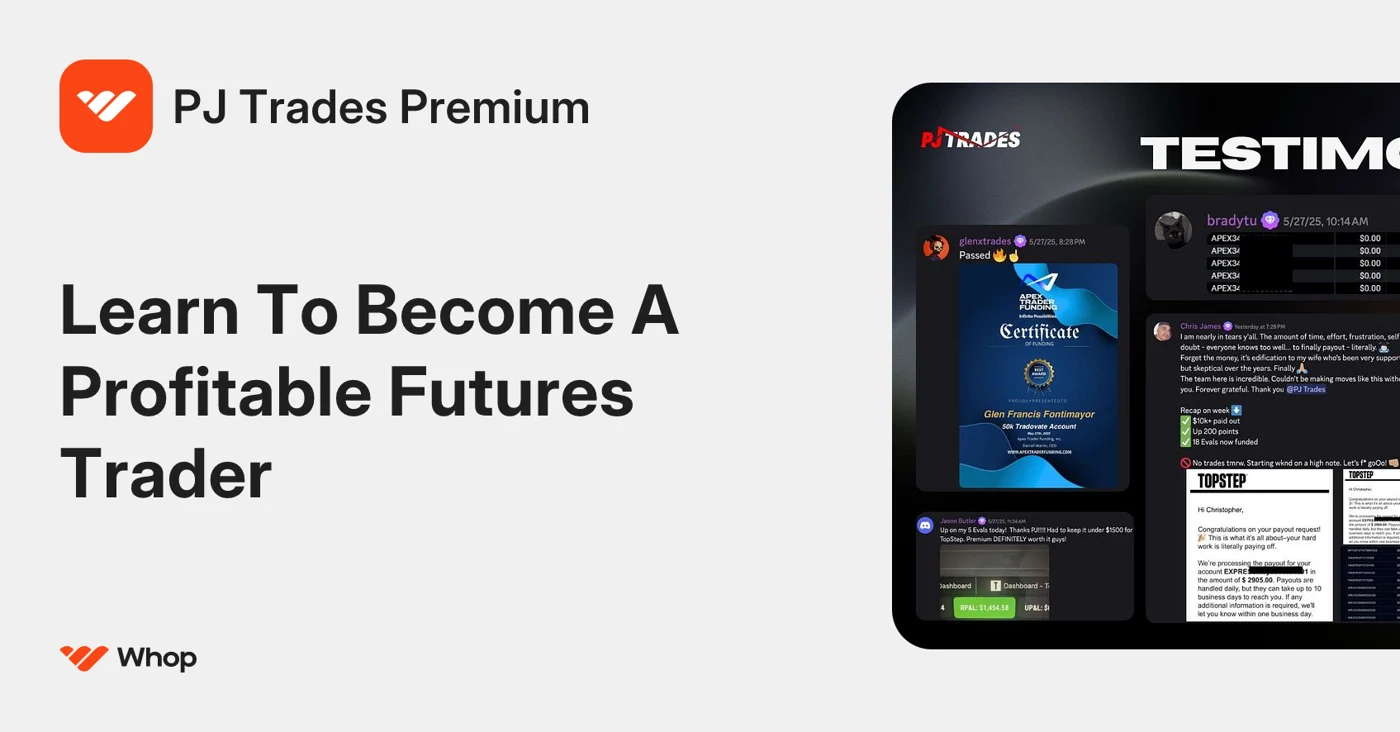
The quick verdict
I’m glad I bought PJ Trades Premium. I got what I wanted out of the membership, and the combination of NQ and ES coverage, live sessions, a starter course, and a paid Discord makes sense to me. The $100 monthly listing matters because much of the value is tied to the live format.
At a glance
- Listed price
- $100 per month on Whop
- Community
- Premium Discord access
- Markets covered
- NQ and ES index futures
- Learning formats
- Starter course, live sessions, and real-time alerts
- Best for
- Learners who want index futures education and can attend live sessions
- Main trade-off
- Recurring cost and live scheduling
What Is PJ Trades Premium?
PJ Trades Premium is a paid futures trading education membership. The main idea is that you get a starter course and a place to watch people discuss the same markets in real time. The setup makes more sense to me when you think of it as somewhere to learn a process over time.
A course on its own has a clear start and finish. You watch the videos, take your notes, and eventually have to figure out what to do with them. A live community adds another layer because you can see how a conversation about the market changes once there’s a real session in front of everybody.
The focus is NQ and ES, which are tied to the Nasdaq-100 and S&P 500 respectively. If you arrived here because you’re looking for a place that covers individual stocks, crypto, and a dozen unrelated strategies, that focus matters. I see it as a strength for someone specifically interested in index futures because the same markets keep coming up.
I like how the course and the community serve different purposes. The course gives the material a sequence, and the live sessions give the subject a real-time setting where the same ideas can come up in messier conditions. That connection is what makes the package work for me.
I think of the membership as education, commentary, and community access. A brokerage account or a prop firm evaluation comes with its own costs and terms. What I got from the membership made me happy with the purchase on its own.
PJ Trades Premium Pricing and What’s Included
Whop lists PJ Trades Premium at $100 per month, and the provider’s site shows the same monthly price. The final checkout total and currency are shown by Whop. That public listing is the price I can point readers to here.
PJ Trades says Premium includes its starter course, live coverage with PJ at the New York open, real-time NQ and ES trade alerts, Asia and New York afternoon livestreams, and access to prop firm giveaways. Premium also includes the free-tier resources. What stands out to me is how much of the paid tier is built around material that changes from session to session.
A monthly price is easy to underestimate because you see it one payment at a time. At the listed rate, three months comes to $300 and six months comes to $600, assuming the price stays the same. I see that recurring cost as the biggest practical trade-off of the membership.
The provider describes the monthly plan as cancel anytime. Cancellation and refunds are different things. The next billing date, access after cancellation, and any refund eligibility depend on the checkout terms.
I see each part of the subscription serving a distinct purpose. The course gives the material a starting point, the live coverage gives the week some structure, and the community keeps the conversation going between sessions.
PJ Trades Premium Features
The starter crash course
A starter course is one of the more useful things a community like this can include. It gives you a place to begin before you open a live session and hear people talking at full speed. That matters if you’re new enough that a handful of unfamiliar terms can make the whole conversation difficult to follow.
Whop calls it PJ’s Starter Crash Course. I like seeing a starter course included because the features on the sales page span a range of difficulty. A course gives a newer member a place to begin when the market discussion is moving quickly.
A useful way to approach a course like this is to keep a few actual questions next to your notes. What does this setup look like? What would tell me I read the situation wrong? Which part of the explanation could I repeat in my own words tomorrow?
That kind of note-taking gives you something to bring into a live session. It also makes it easier to notice whether you understand an idea or whether it just sounded clear while somebody else was explaining it. I like educational resources that give you a way to revisit the basics whenever you hit that gap.
The course also gives the offer some continuity between sessions. A live explanation has to move with the market, while course material gives a topic room to stand on its own. I see that difference in pace as a useful part of the way Premium is put together.
Live sessions at the New York open
PJ Trades says Premium includes its starter course, live coverage with PJ at the New York open, real-time NQ and ES trade alerts, Asia and New York afternoon livestreams, and access to prop firm giveaways. Premium also includes the free-tier resources. What stands out to me is how much of the paid tier is built around material that changes from session to session.
There’s a real difference between seeing a clean chart after the fact and hearing what someone is looking for while several outcomes are still possible. The useful part of a live session can be a decision to wait, a change in how the market is being read, or a moment where the original idea stops making sense. You’d miss much of that if all you saw was the final screenshot.
The schedule is part of the value of the live feature. The New York open anchors the coverage to a particular event, which makes the format predictable. It also means the opening session will be easier for some people to attend than others, especially across time zones.
What interests me about a live session is the way the explanation can change as new information comes in. A chart afterward shows where the market ended up, but the live discussion can show why the presenter kept watching an idea or moved on from it.
The other thing I appreciate about that format is how it leaves room for uncertainty. A recap can make a day look orderly once the outcome is known. A live discussion can show the competing possibilities that made a decision difficult in the first place.
Real-time NQ and ES trade alerts
The provider also lists real-time NQ and ES trade alerts. I understand why people want to know about those before paying. An alert gives you something specific to examine, and the timing makes it possible to see how the idea relates to the market at that moment.
The way I think about this feature is as a prompt to investigate. What was the context around that alert? What would have made the idea invalid? What would someone miss if they saw only the alert and none of the surrounding discussion?
Those questions matter because somebody else’s alert can reach you at a different point from when they acted. Your execution and exposure can be different too. Even when you think you recognize the setup, you still have to understand the risk you would take on yourself.
I see educational value in being able to observe an alert without placing a trade. A group of examples can reveal what those alerts had in common and how much the surrounding explanation matters when making sense of them. That makes alerts one part of learning the material rather than a whole routine on their own.
My take on the alerts is that they matter most as part of the wider membership. A message can identify what drew attention at a particular moment, but it only captures a slice of the discussion. The course and commentary are where the reasoning behind that moment gets more room.
Asia and New York afternoon livestreams
The official site also lists Asia and New York afternoon livestreams for Premium. I like that the offer acknowledges people may be interested in more than the opening session. It gives a prospective member another practical reason to check the full schedule instead of judging the membership from one headline feature.
The additional sessions make the live side of the membership more flexible. I see that as useful for people whose hours don’t line up with the New York open. It also gives the offer more range than the morning headline alone suggests.
Different times of day can give the discussion a different pace. The New York open is the clearest anchor in the offer, while the other windows add coverage around it. For me, that makes the schedule easier to understand as a whole.
Prop firm giveaways
Whop and PJ Trades both mention access to prop firm giveaways. I see that as an extra for members who are already interested in prop firms. The resources and live coverage are what give the subscription its recurring value.
Giveaways come with individual rules, deadlines, and eligibility terms that can change. Any evaluation or funded-account program attached to a giveaway may carry separate rules and costs. I see the giveaway feature as access to an opportunity under those terms.
PJ Trades Premium Discord Community
Yes, the paid PJ Trades membership includes access to its premium Discord community. The provider also offers a free Discord tier, which it describes as including community access, daily trade reviews, educational videos and resources, and weekly market commentary. Premium adds the live sessions, trade alerts, starter course, and other paid features described above.
That free-versus-paid distinction is worth spelling out because the word Discord on its own tells you very little. You can be in a server without having access to the same resources as paid members. What you want to compare is which features belong to each tier and whether those differences matter for what you’re trying to learn.
What stands out to me about the paid community
The value of a community often comes down to what you can do with the information once you’re there. When people talk about a session, can you follow what they were looking at? Can you go back later and make sense of the conversation when you have more time?
I like that a community gives different types of learners a place in the same membership. Some people learn from seeing regular examples and reading other members’ questions. Others get more out of starting with structured material and returning to the discussion when a topic catches their attention.
For this membership, the part that makes sense to me is the connection between topics. You can read up on an idea, see how it’s discussed in a live environment, and return to the material with a better idea of what you still need to understand. That’s a more useful way to think about the Discord than just counting how many things have been added to a server.
Free Discord versus Premium
I see a clear difference between the two tiers. Free gives members a way into the community and its educational posts. Premium is where the provider puts live coverage of the New York open and real-time NQ and ES alerts, which are two of the main reasons the paid offer stands apart.
There’s also no need to assume you’ll use everything the minute you join. Prioritize whichever feature solves the problem you came in with. The rest of the membership can be there when you’re ready to use it.
Premium is sold through Whop, with paid community access in Discord. Those are two different parts of the same membership experience. Whop is the listing and checkout, while Discord is where PJ Trades hosts its community.
That distinction also explains why I see Premium as a membership with a specific focus. Its value sits in the recurring sessions and the resources around them. Someone comparing the tiers can see what the fee adds without assuming that every useful community feature requires a payment.
My Results With PJ Trades Premium
I had a very good experience with PJ Trades Premium and got what I wanted out of it. That’s my reason for writing a positive review. The experience I’m sharing is my overall judgment of the membership, and the individual features above describe what the provider offers.
The way I think about whether something like this worked is pretty simple. Did it give me enough value for the reason I signed up? Would I feel comfortable telling somebody with a similar goal to look at it? For me, the answer to both is yes.
One reason I can explain that recommendation without getting into somebody else’s trading results is that the product has a specific shape. There’s a course you can work through, live coverage you can plan around, and a Discord built around the same subject. That combination is what makes the offer feel coherent to me as a whole.
There’s also an important line between being happy with an education membership and expecting a financial return from it. Futures are leveraged, and the National Futures Association explains that losses can exceed what you expected to commit. A positive experience with the membership gives no basis for predicting anybody’s profit, payout, or account performance.
PJ Trades Premium Pros and Cons
What I like about the offer
The biggest pro is the combination of structured learning and an active format. You can start with the course and then have a reason to come back when the market is open. There are enough different ways to engage that you can give yourself a realistic routine built around the time you have.
The NQ and ES focus is another plus for me. I like knowing which markets a membership comes back to regularly. That specificity gives the course, live sessions, and Discord conversations a shared subject.
Another thing I like is that the provider publishes a free tier. You can get some exposure to its educational content and community format before deciding what the paid sessions and alerts would add for you. That can make the choice less abstract.
The trade-offs to consider
The main one is the recurring cost. The advertised $100 monthly price is easier to justify if you can make use of the live schedule and want the paid resources. The schedule is a real part of the trade-off for anyone who regularly works or commutes during one of the live sessions.
The other trade-off is how easy it is to get distracted. Several live windows, alerts, community conversations, and giveaways can give you plenty to look at. Without a priority it’s easy to spend time consuming information without being able to say what you learned from it.
There’s also a narrower fit if your interests are outside index futures. That specificity is a positive in the context of this review, but it depends on what you want. A product can be a good experience for me and still make more sense for someone who actually wants to spend time with NQ and ES.
The membership fee is also separate from any costs associated with actually trading. I see it as payment for a learning environment, so its value comes from the material and access it provides. Mixing that purchase with the cost of using a broker or joining an evaluation makes it harder to see what each expense buys.
Is PJ Trades Premium Worth It?
For me, yes. I got the value I wanted from my purchase. The combination of a course, live examples, and Discord makes the most sense for someone who is interested in index futures and wants those different formats in one membership.
The live schedule is what makes the fit concrete to me. People who learn well in real time can get more from the different sessions, while the course serves people who like something they can work through at their own pace. Both formats are a meaningful part of why I see value in the package.
The free community serves a different purpose. It includes general commentary and educational material, which can be enough for people who mainly want to follow discussions. Premium makes the most sense to me when the live coverage and the paid resources are the draw.
I was happy with what I got out of the purchase. The fact that it renews monthly also makes ongoing value a separate question from whether I liked it. The parts of the offer that keep changing, especially the live coverage, are what make the recurring format make sense to me.
PJ Trades Premium FAQ
Is PJ Trades Premium a monthly subscription?
The listed offer is $100 per month. The plan and billing terms at checkout determine the charge and renewal date. The provider describes the monthly Premium plan as cancel anytime.
Does PJ Trades Premium include the Discord?
Yes. The provider describes the paid offer as Premium Discord access, with the paid resources and sessions listed for that tier. PJ Trades also advertises a free Discord option with community access and some educational material.
Does the offer include live trading sessions?
The provider says Premium includes going live with PJ at the New York open plus Asia and New York afternoon livestreams. Those are the listed coverage windows. The exact member schedule can change.
Do I need to trade with real money to use it?
You can use educational materials, watch sessions, and review alerts as examples without placing a live trade. Trading decisions are separate from a membership purchase. Leverage and potential losses are separate considerations from the quality of the educational material.
Is the TradingView indicator included?
PJ Trades promotes a TradingView indicator on its website and links to it separately. The public list of Premium benefits does not identify that indicator as part of the membership. I treat it as a separate offer in this review.
Final Recommendation
I’m glad I paid for PJ Trades Premium. I got the results I wanted out of the experience, and the community and live format are what make the offer stand out to me. It has a clear audience in people who want to spend time learning about NQ and ES.
The package makes sense to me because the three main parts work together. The starter course gives the topic a structure, the live schedule puts the conversation in context, and the premium Discord gives that conversation a home. That is the part of the offer I most appreciate.
That’s where I land on the membership. I had a very good experience, and I see the strongest fit for someone who values both the course and the way the community follows the market in real time.
Affiliate disclosure: I may earn a commission if you buy through the links in this review.